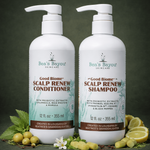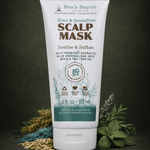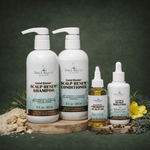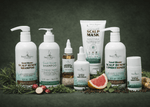


A shampoo is on your hair for a few minutes at most before it's rinsed away — so it's fair to ask whether the argan and flaxseed oil in our YeastDefense® Moisturizing Shampoo are doing anything besides sounding nice on the ingredient list. Here's what the actual research on these two oils says, and what a rinse-out contact window means for how much of that research even applies.
The short version of the science, again
As covered throughout this series, whether an oil penetrates hair fiber or mostly stays on the surface depends heavily on the size and shape of its dominant fatty acid — shorter, straighter, more saturated chains diffuse in more readily than longer, unsaturated ones, which tend to stay closer to the surface (Keis et al., 2005; Determination of penetration and protection of fatty acids in bleached hair, 2023).
Argan oil — 🟡 directly studied, with a genuinely nuanced finding
Argan oil is one of the better-researched oils in this entire series specifically for hair fiber penetration. A 2024 study in the journal Cosmetics applied coconut, avocado, and argan oil directly to virgin and bleached Caucasian hair tresses for 24 hours and used Raman spectroscopy and mechanical testing to see what happened. All three oils diffused into the cortical region of the hair. But the finding for argan oil specifically was more complicated than "it penetrates, so it's good": argan oil increased the hair's water absorption, which in virgin hair actually led to reduced mechanical resistance, and its affinity for the fiber increased further once hair was chemically damaged (bleached) (MDPI, Cosmetics 2024, 11(2), 64).
We're including that nuance because it's a good example of why "does it penetrate" isn't automatically the same question as "is more of it better." Coconut and avocado oil, tested in the same study, reinforced the hair's hydrophobic barrier and increased stiffness and break resistance in virgin hair — a different, arguably more protective outcome than argan oil's water-absorption effect. Argan oil genuinely does something inside the hair fiber; whether that something is uniformly beneficial depends on the hair's condition, which is a more honest and more useful thing to know than a blanket "argan oil deeply nourishes hair" claim.
Flaxseed (Linseed) Oil — ⚪ a real research gap
That hasn't stopped haircare content from claiming it anyway: consumer haircare sources commonly describe flaxseed's fatty acids as small enough to "slip beneath the cuticle," paired with a separate claim that flaxseed's natural mucilage forms a surface film that seals in moisture. We want to be transparent about what that claim actually is — marketing content, not a cited study — and it doesn't explain why a long-chain, unsaturated fatty acid would behave differently than the chain-length-and-saturation research above predicts. A well-regarded, independently run hair-science review of penetrating-versus-coating oils (Science-y Hair Blog) doesn't list flaxseed among its penetrating oils at all.
So here's the honest, layered answer: flaxseed oil is a well-documented moisturizing and anti-breakage ingredient in cosmetic use generally, and it likely does contribute a surface-sealing film. "Penetrates the hair fiber" specifically remains a claim we found in marketing content, not in research.
What a rinse-out contact window actually means here
The bottom line
Sources
- Impact of Hair Damage on the Penetration Profile of Coconut, Avocado, and Argan Oils into Caucasian Hair Fibers (2024). Cosmetics, 11(2), 64. MDPI
- Keis, K., Persaud, D., Kamath, Y.K., & Rele, A.S. (2005). Investigation of penetration abilities of various oils into human hair fibers. Journal of Cosmetic Science, 56(5), 283–295. Journal record
- Determination of penetration and protection of fatty acids in bleached hair according to fatty acid chain length, and the application to understanding the protective effects of MCT oil and coconut oil (2023). Fashion and Textiles. Springer Nature
Ingredient list verified against the live Bea's Bayou product page (beasbayouskincare.com/products/shampoo), fetched 2026-08-25. Claims note: no claim is made that this shampoo treats seborrheic dermatitis, dandruff, or any diagnosed condition, or that its oils repair hair structurally in a single wash — see Product Bible Section 5 and Section 8 Claims and Compliance Matrix. Ingredient-level penetration research is presented as background education, not as proof of finished-formula performance.
In short: argan oil has real (if nuanced) penetration evidence behind it, flaxseed doesn't, and a shampoo's brief contact time limits what either can do before the conditioner step takes over.