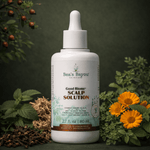
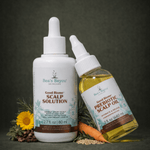
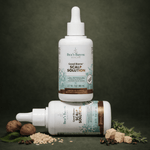
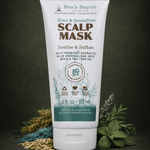
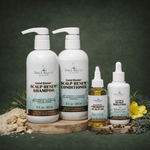
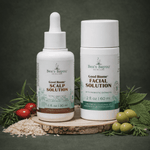
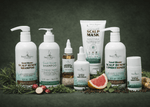
This is a water-and-ferment-forward treatment, not an oil-heavy one — the handful of oils it does contain range from genuinely promising to not backed by the internet's favorite claims.
This formula isn't built around oil at all
Our own product page says it directly: "Unlike thick oil-heavy treatments, this fast-absorbing formula won't weigh hair down or ruin styles." The Scalp Solution is a water-and-ferment-forward leave-in — probiotic ferments, marshmallow root, rice ferment, nettle, and a handful of supporting oils, not an oil-based treatment like our Prebiotic Nourishing Scalp Oil or Calming Zinc & Algae Scalp Mask. That matters for this piece: the oils here are a smaller, supporting part of the formula, and the "does it penetrate" question applies less here than it does to a leave-in or pre-wash oil product.
Still, since we're being thorough across every product, here's what the research says about the specific carrier oils in this formula.
What actually determines whether an oil "penetrates"
The carrier oils in this formula
Hemp Seed Oil — 🟠 mixed, and mechanistically a little contradictory. As with our other formulas containing hemp oil, its fatty acid profile is dominated by linoleic acid — a composition that, by the chain-length-and-saturation principle above, would predict more surface coating than deep penetration. Some consumer sources describe its small molecules moving past the cuticle regardless. A well-regarded, independently run hair-science review of penetrating-versus-coating oils (Science-y Hair Blog) puts hemp seed oil in its non-penetrating, surface-lubricating category — which lines up with the fatty-acid chemistry better than the "penetrates" claim does. We're not resolving the contradiction between that and the consumer claims; we're naming it, and telling you which side the more careful source lands on.
Marula (Sclerocarya Birrea) Seed Oil — 🟠 promising fatty acid profile, no dedicated hair-fiber study. Marula oil is roughly 70–78% oleic acid, a more linear fatty acid generally associated with better cuticle penetration than bulkier polyunsaturated oils (fatty acid composition research on Sclerocarya birrea kernel oils). That's a reasonable chemistry-based inference, not a directly studied fact — the same hair-science review referenced above makes the identical inference, describing marula's penetration as likely "about the same as olive oil" based on the similar fatty acid profile, rather than a marula-specific finding. We said the same thing about marula in our Conditioner blog, and it holds here too.
Rosehip Seed Oil — ⚪ marketing claims outrun the one real study that exists. Rosehip seed oil is dominated by polyunsaturated fatty acids — roughly 54% linoleic acid and 19% linolenic acid, with oleic acid making up the rest. That's a heavily unsaturated profile, which by the same chain-length-and-saturation principle above would predict limited fiber penetration, not the "penetrates deeply" claims common in consumer hair-oil content. A real peer-reviewed comparative study does exist — it tested rosehip alongside grape seed and safflower seed oil on gloss, color change, tensile strength, and cuticle fracture patterns — but grape seed oil (not rosehip) performed best on most measures; rosehip only came out ahead on one tensile-strain test (ACS Omega, 2023). The same hair-science review cited above also categorizes rosehip as non-penetrating. So the popular "penetrates deeply" claim isn't just unproven — the one study that exists doesn't support it either.
Evening Primrose Oil — ⚪ real research exists, but it's testing a different claim. Evening primrose oil is even more concentrated in linoleic acid (roughly 70–74%), plus gamma-linolenic acid (GLA) — a fatty acid profile that predicts surface-level behavior more than deep penetration, and we found no dedicated topical hair-fiber penetration study. Here's the more important distinction, though: real peer-reviewed clinical research on evening primrose oil and GLA does exist — but it studies oral supplementation for atopic dermatitis (skin, not scalp; taken internally, not applied topically), and even that evidence is mixed, with some trials showing benefit and at least one finding no effect (PubMed; PubMed). That's a genuinely different product, delivery method, and health condition than "this topical oil penetrates your scalp" — and we don't think that real research should get borrowed to support a claim it was never testing. It's a genuinely well-documented scalp-comfort and dryness-supporting ingredient in topical cosmetic use generally — that's the claim the evidence actually supports.
Sodium Sunflowerseedate — not the same thing as sunflower oil. This ingredient is a fatty acid derivative of sunflower oil used as a mild cleansing and conditioning agent, not the whole triglyceride oil itself. It doesn't fit the penetration-vs-sealing framework built around intact carrier oils, so we're not scoring it on that scale.
Aromatic and functional oils — Clove Bud, Oregano, Lavender, Bergamot, Tea Tree, Myrrh: these are included at low levels for scent, traditional antimicrobial and circulation-support roles, and sensory tingle — not as penetrating or sealing agents. The penetration framework doesn't really apply to essential oils used this way, so we're leaving them out of the oil-by-oil scoring above.
The honest bottom line
Sources
- Keis, K., Persaud, D., Kamath, Y.K., & Rele, A.S. (2005). Investigation of penetration abilities of various oils into human hair fibers. Journal of Cosmetic Science, 56(5), 283–295. Journal record
- Determination of penetration and protection of fatty acids in bleached hair according to fatty acid chain length, and the application to understanding the protective effects of MCT oil and coconut oil (2023). Fashion and Textiles. Springer Nature
- Fatty acid composition of rosehip seed oil (2013). Characterization of Rosehip (Rosa canina L.) Seed and Seed Oil, Taylor & Francis. Full article
- Evening Primrose (Oenothera biennis) Biological Activity Dependent on Chemical Composition (2018). PMC. NCBI
Ingredient list verified against the live Bea's Bayou product page (beasbayouskincare.com/products/seborrheic-itchy-scalp-treatment-probiotic), fetched 2026-08-25. Claims note: no claim is made that this product "repairs," "cures," or "treats" seborrheic dermatitis or any medical condition — see Product Bible Section 5, approved claim boundaries, and Section 8 Claims and Compliance Matrix. Fatty-acid-composition reasoning is presented as background education about the raw ingredients, not as proof of finished-formula performance.