

Conditioner sits on your hair for a few minutes and then gets rinsed out — so does the oil in it have time to do anything besides coat the outside? It's a fair question, and the honest answer is: it depends entirely on which oil you're talking about.
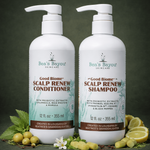
Our Seborrheic Moisturizing Conditioner includes coconut oil, castor oil, and marula oil alongside rice protein, marshmallow root, and a Lactobacillus/tomato-ferment blend. Those three oils sit at very different points on the penetration-versus-sealing spectrum, and the research explains why.
Coconut oil is the most rigorously studied penetrating oil in cosmetic science; castor and marula are doing real, well-supported work at the surface during a normal wash.
The variable that actually matters: fatty acid size and shape
Whether an oil penetrates the hair fiber or mostly stays on the surface comes down to the size, length, and saturation of its dominant fatty acid — not whether it's "natural," and not how it's marketed. Oils built from shorter, straighter, more saturated fatty acid chains move into the hair fiber more readily than oils made of longer, unsaturated chains, which tend to spread out and stay closer to the surface (Keis et al., 2005, Journal of Cosmetic Science). A 2023 study in Fashion and Textiles confirmed the pattern directly: medium-chain fatty acids penetrated bleached hair significantly better than long-chain fatty acids (Determination of penetration and protection of fatty acids in bleached hair, 2023).
With that principle in mind, here's how our three conditioner oils actually stack up.
Coconut oil — 🟢 the best-studied penetrating oil in cosmetic science
Coconut oil is rich in lauric acid, a short, straight, saturated fatty acid — exactly the profile the research above associates with genuine penetration rather than surface coating. A landmark 2003 study comparing coconut oil, sunflower oil, and mineral oil found that only coconut oil meaningfully reduced protein loss from hair, both before and after washing, on damaged and undamaged hair alike (Rele & Mohile, 2003). The 2023 fatty-acid-chain-length study found coconut oil's penetration was comparable to pure medium-chain triglyceride oil (Fashion and Textiles, 2023). Of everything in this conditioner, coconut oil has the strongest, most repeated evidence behind it.
One honest caveat: a 2019 confocal-microscopy study found that, in its specific test formulations, mineral oil actually penetrated better than the vegetable oils tested (Srivastav, Dandekar & Jain, 2019) — a reminder that even coconut oil's advantage isn't universal across every study design.
Castor oil — 🟡 a sealing oil, by broad consensus
Marula oil — 🟠 promising fatty acid profile, limited dedicated research
Marula oil is dominated by oleic acid — roughly 73% of its fatty acid content in recent profiling — with palmitic, stearic, and linoleic acid rounding out the rest (fatty acid profiling research, 2024). Oleic acid's more linear structure is generally associated with better cuticle penetration than the bulkier, more unsaturated fatty acids in oils like sunflower — similar reasoning to why argan oil (also oleic-acid-dominant) is often described as penetrating better than heavier sealing oils. That said, we could not locate a dedicated clinical or microscopy study measuring marula oil's penetration into human hair fibers specifically. A well-regarded, independently run hair-science review of penetrating-versus-coating oils makes the same inference we're making here, in almost the same words — describing marula's likely penetration as "about the same as olive oil" based on its similar oleic-acid-dominant profile, rather than a marula-specific finding (Science-y Hair Blog). That's a second source landing in the same place we did, which is reassuring — but it's still an inference from chemistry, made twice, not a directly studied fact. What's well-supported is its fatty acid composition and its ability to smooth the cuticle and reduce moisture loss at the surface; the deeper-penetration claim is a reasonable inference from its chemistry, not yet a directly studied fact.
What this means for a rinse-out conditioner specifically
Even a penetrating oil needs contact time to do more than sit on the surface — the studies above measure penetration through repeated use and extended exposure, not a five-minute rinse-out window. That's part of why this conditioner is formulated the way it is: castor and marula are doing real, well-supported work at the surface — sealing, smoothing, adding slip and shine — during a normal wash, while coconut oil's presence adds an ingredient with genuine penetration research behind it for anyone who chooses to extend contact time (as a mask, or by detangling and letting it sit a little longer than a quick rinse).
We haven't run penetration testing on this specific finished formula, and we're not going to imply the ingredient-level research above proves what our exact blend does once mixed, diluted, and rinsed within a few minutes. What the research does support is that these three oils were not chosen at random — coconut, castor, and marula sit at genuinely different, well-reasoned points on the penetration-to-sealing spectrum, and that's the actual formulation logic behind combining them.
The bottom line
Sources
- Rele, A.S. & Mohile, R.B. (2003). Effect of mineral oil, sunflower oil, and coconut oil on prevention of hair damage. Journal of Cosmetic Science, 54(2), 175–192. PubMed
- Keis, K., Persaud, D., Kamath, Y.K., & Rele, A.S. (2005). Investigation of penetration abilities of various oils into human hair fibers. Journal of Cosmetic Science, 56(5), 283–295. Journal record
- Determination of penetration and protection of fatty acids in bleached hair according to fatty acid chain length, and the application to understanding the protective effects of MCT oil and coconut oil (2023). Fashion and Textiles. Springer Nature
- Srivastav, A., Dandekar, P., & Jain, R. (2019). Penetration study of oils and its formulations into the human hair using confocal microscopy. Journal of Cosmetic Dermatology, 18(6), 1947–1954. PubMed
- General marula oil fatty acid composition drawn from recent cosmetic-science profiling coverage; no dedicated hair-fiber penetration study was located and none is claimed above.
Claims note: no claim is made that this conditioner "repairs," "restructures," or produces a clinical outcome — see Product Bible Section 5, Product #4, approved claim boundaries. Ingredient-level penetration research is presented as background education, not as proof of finished-formula performance.