If you oil your hair, you've probably wondered this at some point: is the oil actually doing something in there, or is it just coating the outside until your next shampoo washes it all away? It's a fair question, and it turns out the real answer is more interesting — and more specific — than "yes" or "no."
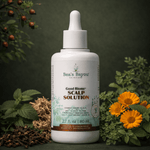
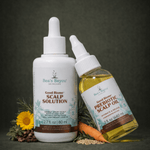
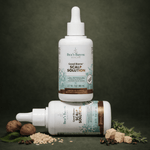
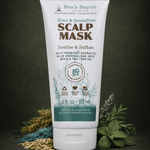
We went looking for the actual published research on this, oil by oil, including the ones we use in our own Calming Zinc & Algae Scalp Mask: castor, sweet almond, wheat germ, rice bran, hemp seed, jojoba, and olive fruit oil (per the current formula listed on our product page). Here's what the science actually supports, what it doesn't yet, and what that means for how you use oil in your routine.
Of the seven oils in this mask, olive fruit oil has the strongest direct evidence, castor is a well-established sealant, and several others are honest research gaps rather than settled science.
The one thing that actually determines whether an oil penetrates
Hair science has a name for this question — "penetrating" oils versus "sealing" (or coating) oils — and the research points to one main variable driving the difference: the size and shape of the oil's dominant fatty acid molecule.
A study by cosmetic scientists Keis and colleagues, published in the Journal of Cosmetic Science in 2005, found that oils made of shorter, straighter, more saturated fatty acid chains diffuse into the hair fiber more easily than oils made of longer chains with double bonds, which tend to spread out and stay closer to the surface (Keis et al., 2005). A more recent 2023 study in Fashion and Textiles confirmed the same pattern directly: medium-chain fatty acids penetrated bleached hair significantly better than long-chain fatty acids, with coconut oil (rich in lauric acid, a medium-chain fatty acid) performing on par with pure medium-chain triglyceride oil (Determination of penetration and protection of fatty acids in bleached hair, 2023).
The reference point nearly all of this research is built on is a well-known 2003 study by Rele and Mohile, which compared coconut oil, sunflower oil, and mineral oil and found that only coconut oil meaningfully reduced protein loss from hair — before and after washing, on damaged and undamaged hair alike (Rele & Mohile, 2003, Journal of Cosmetic Science).
Worth noting up front: coconut oil is not one of the oils in our formulas. We're citing it here because it's the most rigorously studied oil in this entire field, and it's the benchmark every other oil — including the ones we actually use — gets measured against.
One honest caveat before we go further: this field isn't fully settled. A 2019 study using confocal microscopy to directly visualize oil inside cross-sections of human hair found that, in their specific test formulations, mineral oil penetrated better than the vegetable oils they tested (Srivastav, Dandekar & Jain, 2019, Journal of Cosmetic Dermatology) — which complicates the tidy "vegetable oils penetrate, mineral oil just sits there" story you'll see repeated across a lot of hair blogs. We're telling you that because a company that says "where Louisiana plant wisdom meets modern probiotic research" doesn't get to quietly leave out the research that doesn't fit the story.
What the research says about the oils we actually use
Here's where we get specific — and honest about where the evidence is strong, where it's thin, and where it just doesn't exist yet for a given oil.
Castor oil — 🟡 primarily a sealing oil, by broad consensus. Castor oil's main fatty acid, ricinoleic acid, is a notably large, viscous molecule — exactly the profile the penetration research above associates with staying on the surface rather than diffusing into the fiber. That's consistent with why castor oil is widely used in hair care as a sealant: it's good at coating the hair shaft, holding in moisture that's already there, and smoothing the cuticle from the outside. We didn't find one single landmark peer-reviewed study that measured castor oil's penetration depth the precise way coconut oil has been measured — the evidence here is consistent cosmetic-chemistry consensus built on its known fatty acid structure, not one gold-standard trial. We think that's still worth telling you, plainly, rather than dressing it up as more settled than it is.
Sweet almond oil — 🟠 genuinely mixed evidence. This is the most honest thing we can tell you about almond oil: the research is thin, and what exists doesn't agree with itself. Some sources point to almond oil's smaller molecular structure allowing some movement beneath the cuticle; others describe its dominant fatty acid (oleic acid, roughly 70% of the oil) as staying mostly on the surface layer. And notably, we could not locate a dedicated clinical study measuring sweet almond oil's actual effect on hair fiber mechanics, shine, or hydration — the case for it currently rests more on its fatty acid composition and general lipid science than on direct evidence. We're not going to pretend otherwise.
Wheat germ oil — 🟠 real nourishment profile, unverified for the specific claim of whole-oil penetration. What's well-documented is wheat germ oil's exceptionally high vitamin E (tocopherol) content — among the richest of any commonly used carrier oil. Some of the penetration research we found on tocopherol specifically studied tocopherol acetate, an isolated, differently formulated vitamin E derivative added into cosmetic products — not whole wheat germ oil's natural triglyceride penetrating as a unit. That's an important distinction: an ingredient's individual component being studied is not the same as the whole oil being studied. This is also the thinnest oil on our list for secondary sourcing — we couldn't find a single cosmetic-chemist, dermatologist, or trade-publication source addressing wheat germ oil's hair-fiber penetration specifically, only general consumer haircare content. We didn't find a dedicated penetration study on whole wheat germ oil itself, and we're not going to manufacture confidence we don't have.
Rice bran oil — ⚪ not yet studied for this specific question, and the secondary sources disagree with each other. Rice bran oil is genuinely rich in gamma-oryzanol, a real antioxidant compound with documented research behind it — mostly in skin delivery and hair-growth-promoting extract studies. Consumer haircare content describes its oleic/linoleic fatty acid profile (roughly 38–48% oleic, 16–36% linoleic) as giving it a lightweight, fast-absorbing feel suited to fine hair. A well-regarded, independently run hair-science review of penetrating-versus-coating oils (Science-y Hair Blog) puts rice bran oil in the non-penetrating, surface-lubricating category instead — directly at odds with the "fast-penetrating" consumer framing. We could not locate research measuring whether or how deeply rice bran oil's triglycerides actually penetrate the hair cuticle, so we're passing along both the popular claim and the more careful source's disagreement with it, rather than picking whichever sounds better.
Hemp seed oil — 🟠 mixed, and mechanistically a little contradictory. Hemp seed oil is dominated by linoleic acid (roughly half its fatty acid profile) along with oleic and alpha-linolenic acids — a highly polyunsaturated oil. Going strictly by the chain-length-and-saturation principle from the Keis and 2023 studies above, that composition would predict hemp oil leans toward surface coating rather than deep penetration. At the same time, we found at least one source describing hemp oil's small molecules migrating past the cuticle into the cortex. The same independent hair-science review referenced above categorizes hemp seed oil as non-penetrating and primarily lubricating, which lines up better with the fatty-acid chemistry than the "migrates into the cortex" claim does. We're presenting both, because picking the one that sounds better isn't how we want to talk about our own ingredients.
Olive (Olea Europaea) Fruit Oil — 🟡 moderate, directly studied penetration. This is one of the better-evidenced oils in this formula. The same 2005 Keis et al. comparative study cited above tested olive oil directly and found it, along with avocado oil, was better absorbed into hair fiber than sunflower oil or jojoba oil — consistent with olive oil's oleic-acid-dominant profile, which lets it insert between cuticle scales more readily than bulkier or wax-based oils (Keis et al., 2005). It's a real, if moderate, penetration finding — not in the same tier as coconut oil's documented protein-loss reduction, but genuinely evidenced rather than inferred.
Jojoba Seed Oil — 🔵 a different category, not a triglyceride at all. Jojoba oil isn't chemically an "oil" in the same sense as the others on this list — it's a liquid wax ester, structurally closer to human sebum than to a plant triglyceride. That's exactly why it's in this formula: it conditions and balances the scalp without heaviness, which fits a mask meant to reset an oil-imbalanced scalp. The same Keis et al. 2005 comparison referenced above for olive oil also included jojoba, and found it penetrated less than olive or avocado oil in that study — consistent with its wax-ester structure sitting closer to the surface. A well-regarded, independently run hair-science review reaches the same conclusion by a different route: because jojoba is a large wax-ester molecule rather than a small triglyceride, it's grouped with surface-coating oils like argan rather than penetrating ones (Science-y Hair Blog). We're not calling that a strike against it; sebum-mimicking surface conditioning is a genuinely different, useful job than fiber penetration, and it's the job jojoba is actually formulated to do here.
What "how many minutes until oil absorbs" articles are actually measuring
You've probably seen the claims: "oil absorbs into hair in 10 to 30 minutes," "leave it in for 2 to 6 hours for best results." We want to name something plainly: those numbers are describing how long it takes for oil to stop looking or feeling wet and shiny on the outside of your hair — a sensory, visual change. That is a genuinely different phenomenon from fiber penetration as it's measured in the actual research above, which looks at things like protein-loss prevention after repeated washing, or oil visualized inside cross-sections of the hair shaft under a microscope, sometimes over the course of days, not minutes.
In other words: your hair can stop looking oily well before (or without) any oil actually making it past the cuticle. Those two things get talked about as if they're the same experience. They aren't, and it's worth knowing the difference when you're deciding how long to leave a treatment in.
What this actually means for how you use our Calming Zinc & Algae Scalp Mask
The bottom line
Whether an oil penetrates or seals mostly comes down to the shape and size of its dominant fatty acid — and the honest answer, oil by oil, is that some of what gets confidently claimed about hair oil online is well-supported (coconut oil's penetration is genuinely one of the better-studied findings in cosmetic science, and olive oil's moderate penetration is directly evidenced in the same comparative study), some of it is reasonable but unproven (almond, wheat germ, hemp), and some of it just hasn't been researched yet (rice bran, specifically for this question). Castor oil's role as a surface sealant is the most consistently supported claim among our own oils, and jojoba's wax-ester structure puts it in its own category entirely — everything else deserves a little more humility than the internet usually gives it.
We'd rather tell you that than make you a promise the research can't back up yet.
Sources
- Rele, A.S. & Mohile, R.B. (2003). Effect of mineral oil, sunflower oil, and coconut oil on prevention of hair damage. Journal of Cosmetic Science, 54(2), 175–192. PubMed
- Keis, K., Persaud, D., Kamath, Y.K., & Rele, A.S. (2005). Investigation of penetration abilities of various oils into human hair fibers. Journal of Cosmetic Science, 56(5), 283–295. Journal record
- Determination of penetration and protection of fatty acids in bleached hair according to fatty acid chain length, and the application to understanding the protective effects of MCT oil and coconut oil (2023). Fashion and Textiles. Springer Nature
- Srivastav, A., Dandekar, P., & Jain, R. (2019). Penetration study of oils and its formulations into the human hair using confocal microscopy. Journal of Cosmetic Dermatology, 18(6), 1947–1954. PubMed
A note on how we researched this: general background on sweet almond, wheat germ, rice bran, and hemp seed oil composition and cosmetic use was drawn from multiple industry and cosmetic-science sources; where a claim about penetration specifically could not be traced to a dedicated peer-reviewed study, we've said so directly in the text above rather than presenting it as more settled than it is.