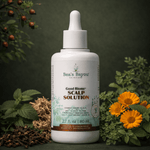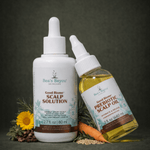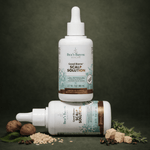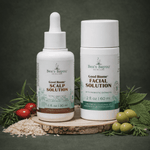


We've spent this series asking whether hair oils actually sink into the hair fiber. Our YeastDefense®️ Prebiotic Facial Solution is a different kind of product entirely, so this piece asks a related but genuinely different question: what does it actually take for something applied to skin to get past the surface?
One correction first, because we got it wrong in an earlier version of this article and we'd rather fix it in the open. We described this as an oil-based serum. It isn't. Read the ingredient list top to bottom and the first things you hit are aloe leaf juice and witch hazel — then a solubilizer, ferments, inulin, panthenol, glycerin. It's an essence: a water-based formula with a small fraction of oils blended into it. The oils are real and they're doing a job, but they aren't the foundation.
That correction matters more than it might sound, because two of the best-evidenced ingredients in this entire formula live in that water phase — and the earlier version of this piece never mentioned them.
Skin absorption isn't the same science as hair-fiber penetration
Hair fiber penetration (the topic of the rest of this series) is about whether an oil moves through the hair's outer cuticle into the cortex underneath. Skin absorption is about a completely different structure: the stratum corneum, the skin's outermost, densely packed layer of dead skin cells and lipids that acts as the body's main barrier against, well, everything — including most of what we put on our skin.
The most widely cited rule of thumb in dermatology for whether a compound can get through that barrier at all is the "500 Dalton rule": a 2000 paper in Experimental Dermatology proposed that molecules much over roughly 500 Daltons don't readily cross the stratum corneum, based on patterns across known contact allergens and topical drugs (Bos & Meinardi, 2000). Worth being precise about what that is, though: it's a rule of thumb the authors proposed as guidance for drug development, reasoned from which compounds were already known to work — not a measured law. And it's about whether a molecule crosses at all, not how deep it goes once it does.
That distinction gets lost constantly. You'll see it said that serums work because smaller molecules go deeper. That isn't quite right. Below the threshold, how oil-loving or water-loving a molecule is matters more than its size — and that has a sweet spot rather than a straight line, because a molecule can just as easily be too oil-loving to move on as too water-loving to get in. Among ingredients that are all small enough, smaller doesn't mean deeper.
So the honest starting point for any skincare ingredient conversation is: most of what's in a serum, including most oils, isn't crossing deep into the skin. A lot of it is doing real work at or near the surface — and for a leave-on facial product, that's not the consolation prize. That's the mechanism.
What's actually in the water
Glycerin is about as well-established as cosmetic ingredients get — decades of research on how it hydrates the stratum corneum, plus a documented role in the process by which skin sheds dead cells properly.
And it's the perfect ingredient for this particular article, because glycerin is a very small molecule and it works at the surface. That's not a shortfall. Holding water in the outer layer of your skin is the entire job. If size determined depth, glycerin would be the deepest-acting ingredient in skincare — and instead it's the proof that surface work is real work.
Panthenol has something rarer in cosmetic ingredients: randomized controlled trial evidence. In one trial, 2.5% dexpanthenol applied twice daily for a week measurably improved skin hydration and reduced water loss compared with the base alone.
We'll be precise, because precision is the point of this series. That trial used a richer, oilier base than ours, and most of the research on panthenol uses a higher concentration. So what we can tell you is that the ingredient itself has real clinical evidence behind it for hydration and water loss. What we can't tell you is that our finished bottle reproduces that trial's result — because nobody has tested our finished bottle.
There's also a formulation decision here that's easy to miss. Third on the ingredient list is a solubilizer, and its job is unglamorous: it holds a small amount of oil clear and evenly dispersed in a water base. That's what lets oil-soluble ingredients live in something that feels like water instead of grease. A formula isn't a list of ingredients. It's a set of decisions about how to get each one where it needs to go.
What research says about oils and skin, specifically
A widely cited 2018 review in the American Journal of Clinical Dermatology looked at the evidence behind plant oils used in skincare — including sunflower, olive, coconut, jojoba, and argan oil — and found that most of them function primarily as occlusive moisturizers: they sit on the skin surface and form a layer that slows water loss from the stratum corneum, rather than delivering their fatty acids deep into living skin tissue (Vaughn, Clark, Sivamani & Shi, 2018). That same review found that an oil's fatty acid ratio matters for barrier repair specifically: oils higher in linoleic acid relative to oleic acid were associated with better barrier-repair potential, while oils higher in oleic acid could be more irritating to a compromised barrier in some cases.
That's a genuinely different conclusion than what the hair-fiber research in the rest of this series has shown, where linoleic-acid-dominant oils (like sunflower) were found to penetrate hair fiber less well than shorter-chain saturated oils. We want to name that directly rather than let it look inconsistent: hair fiber and skin are different structures, so the same fatty acid can behave differently — and matter differently — depending on which one you're applying it to.
The actives in this formula are built to do what oils generally don't
Where this serum is actually designed around penetration, rather than surface conditioning, is its two acids:
Salicylic Acid (BHA) is oil-soluble, which is exactly why it's able to move past the oily buildup at the surface and into the pore itself, where it works on excess sebum and dead skin cells — this is well-established, widely used dermatological chemistry, not a novel claim. It's a small molecule, well under the 500 Dalton threshold, consistent with the general rule above.
Lactic Acid (AHA) is water-soluble and works differently: rather than traveling into the pore, it loosens the bonds between dead skin cells at the very surface of the stratum corneum, which is how AHAs create smoother texture and more even tone over repeated use. This is a surface-level mechanism, and that's not a limitation — it's simply a different job than what a BHA does.
The oils in this formula
One framing note before the list, because it changes how to read it. Several of these oils have no study testing whether they penetrate skin. We say so each time. But for an oil whose role is sitting on the surface and slowing water loss, penetration was never the relevant test — so a missing penetration study isn't a mark against the ingredient. It's a question that doesn't apply. What matters for these is fatty acid profile and barrier support, and that's what we've reported.
Sunflower Seed Oil (organic) — 🟢 favorable for skin barrier support, per the Vaughn et al. review above, precisely because of its high linoleic acid content — the same trait that made it a weaker performer in the hair-fiber research earlier in this series. Context matters here.
Prickly Pear (Opuntia Ficus-Indica) Seed Oil — 🟡 better-documented than most oils on this list. Peer-reviewed fatty acid profiling puts this oil at roughly 60–70% linoleic acid, with oleic and palmitic acid rounding it out (characterization research on prickly pear seed oils; habitat/fatty-acid composition study). That high linoleic-acid content is specifically the fraction the barrier-repair research cited earlier (Vaughn et al., 2018) associates with better barrier-repair potential — so while we didn't locate a study testing this exact oil's absorption or penetration into skin, its fatty acid profile places it in the same evidence-backed category as sunflower oil above, which is a stronger position than most of the oils in this formula.
Rosehip Seed Oil — 🟠 similarly linoleic-acid-dominant (see our Scalp Solution piece for the full fatty acid breakdown), which fits the same favorable-for-barrier-support category described above. Rosehip oil has more general skincare research interest than most oils on this list, but we didn't verify a specific dedicated study for this piece, so we're not citing one.
Hemp Seed Oil — 🟠 also linoleic-and-omega-3-rich, plausibly barrier-supportive by the same reasoning, without a dedicated study located specifically for skin penetration or barrier repair. Hemp's roughly 3:1 ratio of omega-6 to omega-3 fatty acids is close to what's considered ideal for skin, and dermatologists interviewed on the topic describe linoleic acid generally as feeding into the skin's own ceramide production — a plausible, dermatologist-sourced mechanism for barrier support, though still not a penetration study of hemp oil itself.
Black Walnut Oil — ⚪ we did not find dedicated skin-penetration or barrier-repair research on this oil, and we're not going to dress up what's there. We also went looking for the traditional-use record — who used black walnut for skin, where, which part of the plant, prepared how — and couldn't establish it at the level we'd want before telling you about it. General reference sources describe traditional use, but they're upfront that it isn't backed by clinical study, and they don't answer those questions either. So: it's here as a heritage ingredient, and that's the honest description of it. If the record turns out to be better documented than we could verify, we'll come back and say so.
Aromatic and functional oils — Tea Tree Leaf Oil, Clove Flower Oil, Grapefruit Seed Oil, Sweet Orange Oil: included at low levels for their traditional antimicrobial, brightening, and soothing roles rather than as barrier-repair or penetration-focused ingredients — the same category treatment we've used for essential oils throughout this series.
The bottom line
The honest story here isn't "everything in this bottle sinks in" or "nothing does" — it's that different ingredients are doing genuinely different jobs, and a good formula is a set of decisions about getting each one where it needs to go.
The salicylic acid is oil-soluble, which is why it behaves differently from the AHA — it mixes with the lipids at the surface and in the pore itself. The lactic acid works at the very surface, loosening the bonds between dead skin cells, because that's where its mechanism happens. The humectants hold water in the outer layer. The oils support the skin's own barrier, slowing water loss and offering the fatty acids research associates with a healthier-functioning barrier.
And the reason all of that can coexist in something that feels like water rather than oil is a solubilizer sitting third on the ingredient list, doing an unglamorous job well.
None of that is "penetrates deep into your skin." Honestly, it's better than that — it's a formula where each ingredient does the thing it's actually good at, at the depth where that thing happens. A well-supported barrier is a real, evidence-backed reason to use this. It's just a different claim than the one the industry usually makes, and we'd rather describe ours accurately than borrow language that isn't ours to use.
Sources
- Bos, J.D. & Meinardi, M.M.M. (2000). The 500 Dalton rule for the skin penetration of chemical compounds and drugs. Experimental Dermatology, 9(3), 165–169. PubMed
- Vaughn, A.R., Clark, A.K., Sivamani, R.K., & Shi, V.Y. (2018). Natural Oils for Skin-Barrier Repair: Ancient Compounds Now Backed by Modern Science. American Journal of Clinical Dermatology, 19(1), 103–117. PubMed
Ingredient list verified against the live Bea's Bayou product page (beasbayouskincare.com/products/prebiotic-facia-solution-liquid-serum), fetched 2026-08-25. Claims note: no claim is made that this product treats acne, eczema, or any diagnosed skin condition, or that it delivers ingredients "deep" into skin tissue — see Product Bible Section 5 and Section 8 Claims and Compliance Matrix. Fatty-acid and mechanism reasoning is presented as background education about the raw ingredients, not as proof of finished-formula performance.
This is an essence, not a face oil — aloe and witch hazel come first, oils are a small fraction. Most of it works at or near your skin's surface, and for a leave-on facial product that's the mechanism, not a limitation.